The methods that make up traditional Chinese medicine, how practitioners combine them, and what it takes to train and become licensed in this province.
Acupuncture is the part of Chinese medicine most people know, but it is one branch of a wider system. This page sketches the main methods a practitioner might use, explains why they are so often combined, and then turns to the practical side many readers search for: where you study Chinese medicine in Calgary and how licensing works in Alberta.
The Core Methods
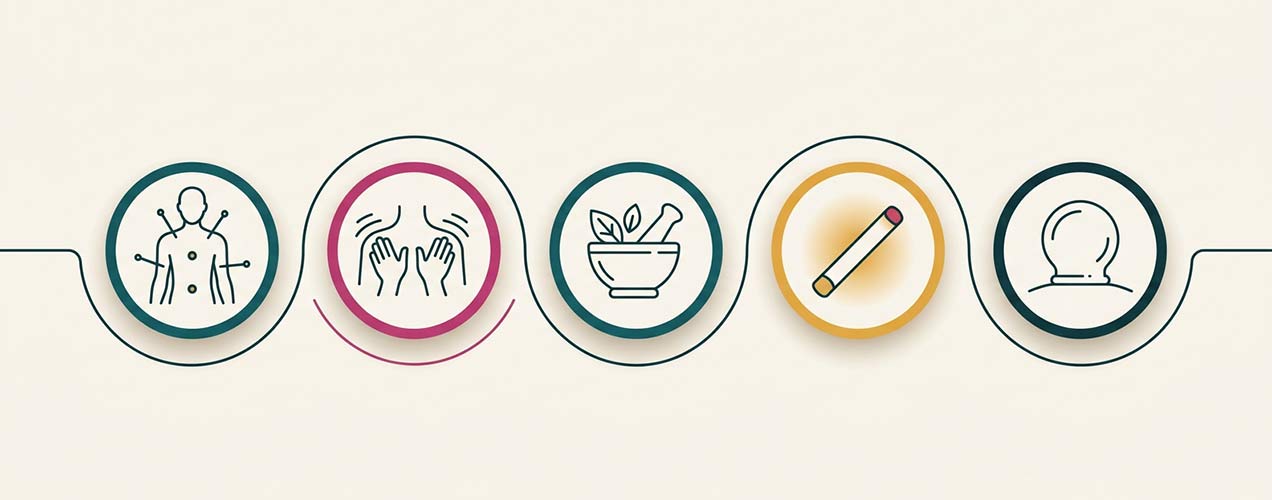
Traditional Chinese medicine (TCM) rests on a handful of related practices. Each can stand alone, but they share the same underlying theory of qi, balance and the channels that run through the body.
- Acupuncture. Fine, single-use needles placed at specific points to prompt a physiological response. It is the most studied of the methods and the only one regulated as a standalone profession in Alberta.
- Tui Na. Chinese therapeutic massage that works the same channels by hand, with kneading, pressing and stretching rather than needles.
- Chinese herbal medicine. Individualised formulas, usually combinations of plant and mineral ingredients, prescribed to match a person’s pattern rather than a single symptom.
- Moxibustion. Burning a small amount of the herb mugwort at or near a point to warm it. It is often used alongside acupuncture rather than on its own.
- Cupping. Suction cups placed on the skin to draw up tissue and, in TCM terms, move stagnation and improve local circulation. The round marks it can leave are temporary.
Why They Are Used Together
Practitioners rarely treat with a single method in isolation. A session might pair acupuncture with cupping, or follow needling with a herbal formula to continue the work at home. The logic comes from how TCM frames health: as a state of balance that treatment is meant to restore rather than a single broken part to fix. Different methods are seen as different ways of nudging the same system, so combining them is the norm, not the exception. None of this is a promise of a cure. It is simply how the tradition is practised.
Studying Chinese Medicine in Calgary
If you are looking into an acupuncture school in Calgary, the long-standing option is the Alberta College of Acupuncture and Traditional Chinese Medicine (ACATCM), which has run since 1997 and is now a degree-granting institution. It offers several pathways, summarised below.
| Program | Length | Leads to |
|---|---|---|
| Acupuncture Diploma | 3 years | Eligibility to register as a Doctor of Acupuncture (Dr.Ac). |
| TCM Diploma (double major) | 4 years | Acupuncture plus full TCM theory and herbal practice. |
| Bachelor of Acupuncture (B.Ac) | 4 years | Alberta’s first acupuncture degree, first intake Fall 2026. |
Whichever route a student takes, the destination is the same national hurdle: the Pan-Canadian Licensing Examinations, administered by CARB-TCMPA and offered twice a year. Passing them is a requirement for registration as an acupuncturist in Alberta.
Licensing and Regulation
In Alberta, acupuncture is a regulated health profession under the Health Professions Act. The College of Acupuncturists of Alberta (CAA) is the regulator: it sets standards, keeps the register, and protects the titles. Only its members may call themselves a registered acupuncturist (R.Ac) or doctor of acupuncture (Dr.Ac), and a current practice permit must be displayed where treatment is given.
Separate from the regulator is the Alberta Association of Acupuncturists and TCM Doctors (AAATCMD), a professional association rather than a licensing body. The distinction matters: a College regulates in the public interest and can discipline members, while an association represents practitioners and offers a public directory. For Chinese herbal medicine and other TCM methods specifically, note that Alberta’s regulation centres on acupuncture; the herbal and bodywork sides are not licensed in the same standalone way.
A word on herbal safety
Herbs are not automatically harmless
Chinese herbal formulas are medicine, and “natural” does not mean risk-free. They can interact with prescription drugs, including blood thinners and blood-pressure medication. Use a qualified practitioner, tell them everything you already take, and be mindful of sourcing and quality, since product standards vary. If you are pregnant, nursing, or managing a chronic condition, run any formula past your physician as well.
To go deeper on the most-studied method, see how acupuncture works and what it treats, on the hands-on side Chinese therapeutic massage in Calgary, or start from the overview of acupuncture in Calgary.
FAQ
Typically, three to four years of full-time study at a recognised school such as ACATCM, followed by the Pan-Canadian Licensing Examinations and registration with the College of Acupuncturists of Alberta. Part-time routes take longer.
Yes. ACATCM has operated in Calgary since 1997 and offers diploma routes plus, from Fall 2026, Alberta’s first Bachelor of Acupuncture degree.
The College of Acupuncturists of Alberta is the regulator that licenses practitioners and protects titles. The AAATCMD is a professional association that represents members and lists them publicly. Only the College grants the right to practise.
Not in the same way. Alberta regulates acupuncture as a standalone profession, but herbal medicine and Tui Na are not separately licensed here, which is one more reason to choose a well-trained practitioner.
Yes, and they often are. A practitioner may pair acupuncture with cupping or moxibustion, or send you home with a herbal formula, depending on what they are treating.